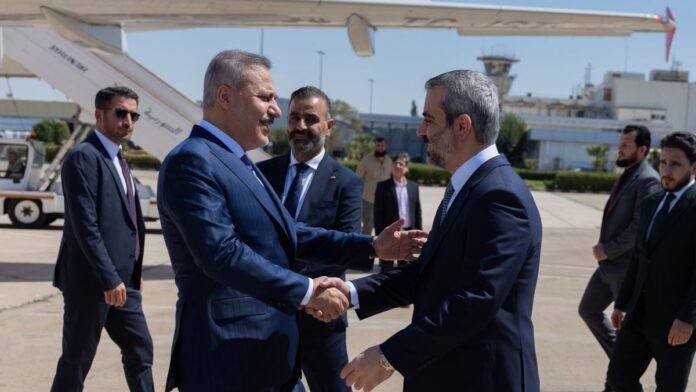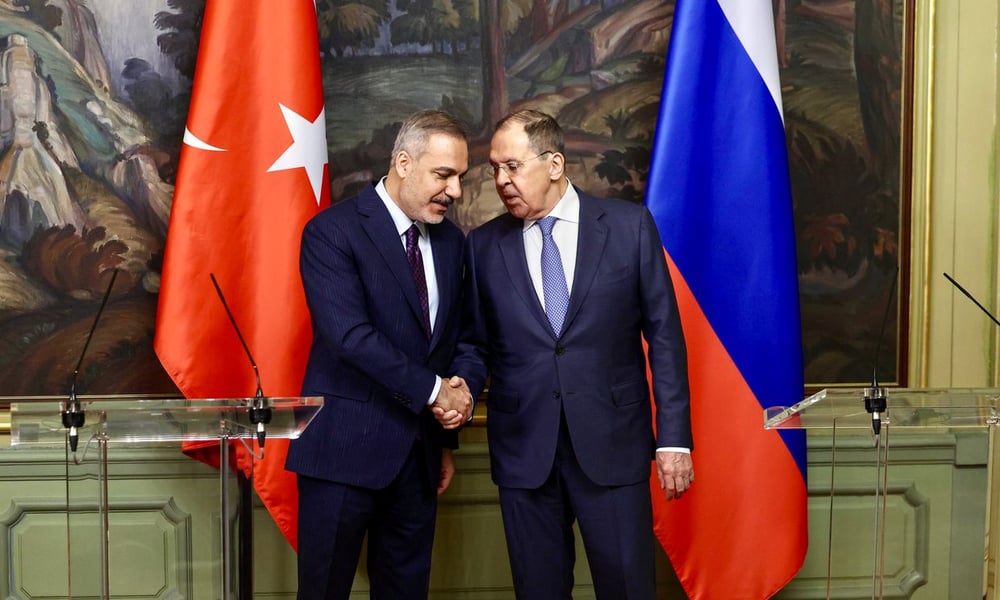

MOSCOW – He is the only senior minister from a NATO member state who holds working relationships with both Kyiv and Moscow, with both Washington and Tehran’s interlocutors, and who has already chaired the most significant face-to-face talks between Russian and Ukrainian delegations in three years. And on Monday, Hakan Fidan flew to Moscow.
Russia’s Foreign Ministry announced Sunday that Fidan, Turkey’s foreign minister, would arrive in the Russian capital for a three-day working visit running through June 17, during which he is scheduled to hold talks with his Russian counterpart Sergey Lavrov. The agenda, as outlined by Moscow, covers the Middle East, the Palestinian question, Black Sea shipping security, and Syria. What the statement left unsaid is that Fidan arrives at a moment of exceptional complexity for both countries, and for him personally.
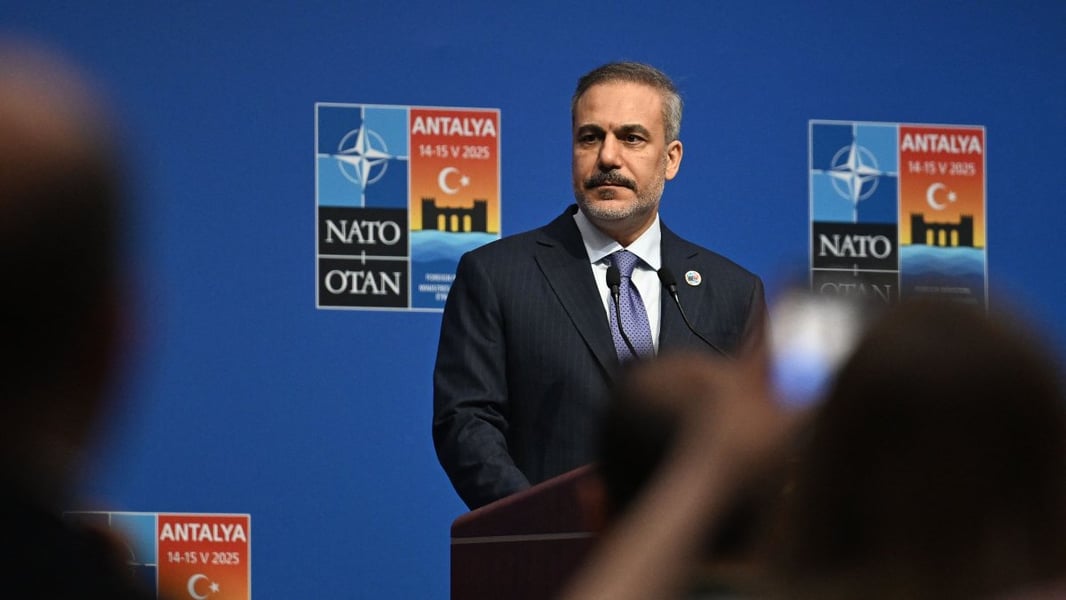
Three weeks from now, Fidan will host a gathering of leaders whose official position is that Russia poses the most significant and direct threat to allied security in the Euro-Atlantic area. The 2026 NATO summit opens on July 7 at the Bestepe Presidential Compound in Ankara. Among the first things on the agenda will be commitments to raise defense spending to 5 percent of GDP – a number designed to counter a country with which Fidan will have spent three days consulting this week.
The symmetry is deliberate. Turkey under President Recep Tayyip Erdogan has long argued that its value to both sides of every conflict is the source of its influence, not a contradiction to be explained away. Fidan embodies that argument more completely than any other figure in Ankara’s diplomatic corps. As a former intelligence chief who ran Turkey’s MIT for thirteen years before taking the foreign ministry in 2023, he knows how to hold confidences that others cannot share. That, analysts say, is precisely why Moscow agreed to receive him now.
The Russian Foreign Ministry’s statement described plans to exchange views on what it called the tense situation in the Middle East, referencing what Moscow characterized as US-Israeli aggression against Iran, and to discuss the Palestinian question and prospects for a resolution. Both Russia and Turkey have called for an immediate halt to hostilities in the region, though their leverage over the parties involved differs considerably. Russia has positioned itself as a potential mediator with Tehran, while Turkey has maintained back-channel contacts with both the Gulf states and the Palestinian Authority.
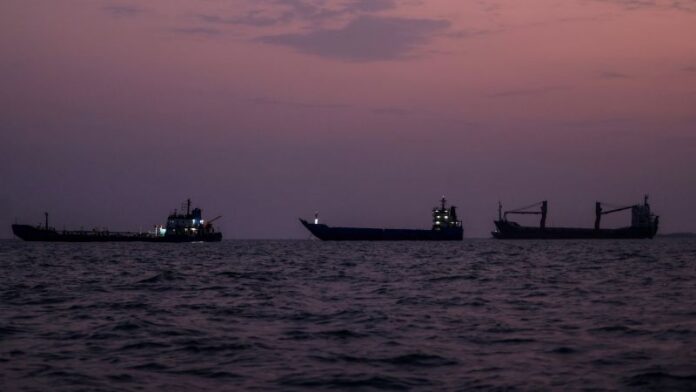
The Black Sea item on the agenda carries its own weight. Moscow said the two ministers would discuss what it called issues of safe navigation in the region – a formulation that refers, in practice, to the unresolved question of commercial shipping through waters that have been contested since Russia’s military operation in Ukraine began in 2022. Turkey’s position is structurally unique: under the 1936 Montreux Convention, Ankara controls passage through the Turkish Straits linking the Black Sea to the Mediterranean, and its interpretation of those rules has shaped which warships can and cannot enter the contested waters. That gives Fidan something tangible to offer in Moscow that no other visiting minister can.
What Fidan’s visit does not formally include – at least in official statements – is a direct conversation about Ukraine. But it would be extraordinary if the subject were avoided. Turkey hosted the May 16 talks between Russian and Ukrainian delegations in Istanbul, the most substantive diplomatic contact between the two sides in years. Fidan described those sessions as a turning point. Moscow’s formal position is that further talks are welcome, with Lavrov having endorsed Istanbul as a venue in a joint press conference with Fidan last month. The next round, if it happens, requires Ankara’s continued coordination with both capitals, and that coordination is not something that can be managed over the phone.
Syria rounds out a crowded docket. Russia and Turkey, once bitter adversaries over Syrian territory, have spent years building a joint framework for managing Damascus’s transition. The Foreign Ministry statement said the ministers would discuss what it called assistance to the new Syrian authorities in establishing an inclusive political dialogue and restoring social and economic life to a peacetime footing. That framing reflects a shift in Moscow’s posture in Syria – less military patron, more diplomatic co-manager, particularly now that Russian attention and resources remain fixed on Ukraine.
Analysts who follow Russian-Turkish relations caution against reading the visit as a signal of alignment. As one independent assessment of the talks noted, the negotiations between Ankara and Moscow have never been about friendship but about a balance of interests. Turkey remains a competitor to Russia in several arenas, including the South Caucasus, where Ankara’s strategic partnership with Azerbaijan – enshrined in the Shusha Declaration signed on June 15, 2021, exactly five years before Fidan’s arrival – has steadily displaced Moscow’s influence since the 2020 Nagorno-Karabakh war.
That anniversary is unlikely to have been lost on either side. Fidan’s three-day presence in Moscow beginning on the fifth anniversary of the Shusha Declaration is a reminder of how much Turkey’s regional footprint has grown in the years Russia has been occupied elsewhere. Moscow needs Ankara’s neutrality, if not its support, on too many files to afford a confrontation. Ankara needs Moscow’s restraint on enough of the same files to make the trip worthwhile.
What the visit cannot produce, however, is visible. No formal ceasefire architecture for the Middle East can emerge from a bilateral Russian-Turkish ministerial. No written framework for Black Sea navigation has yet materialized from years of discussion. What it can do is maintain the working relationship that makes all of those outcomes possible if they come – and that, at a moment when formal diplomatic channels across the region have narrowed dramatically, is not a trivial purpose.
Whether Putin will also receive Fidan during the visit – as he has during previous trips to Moscow – has not been confirmed. The Kremlin said nothing on the subject Sunday. That, too, is information.