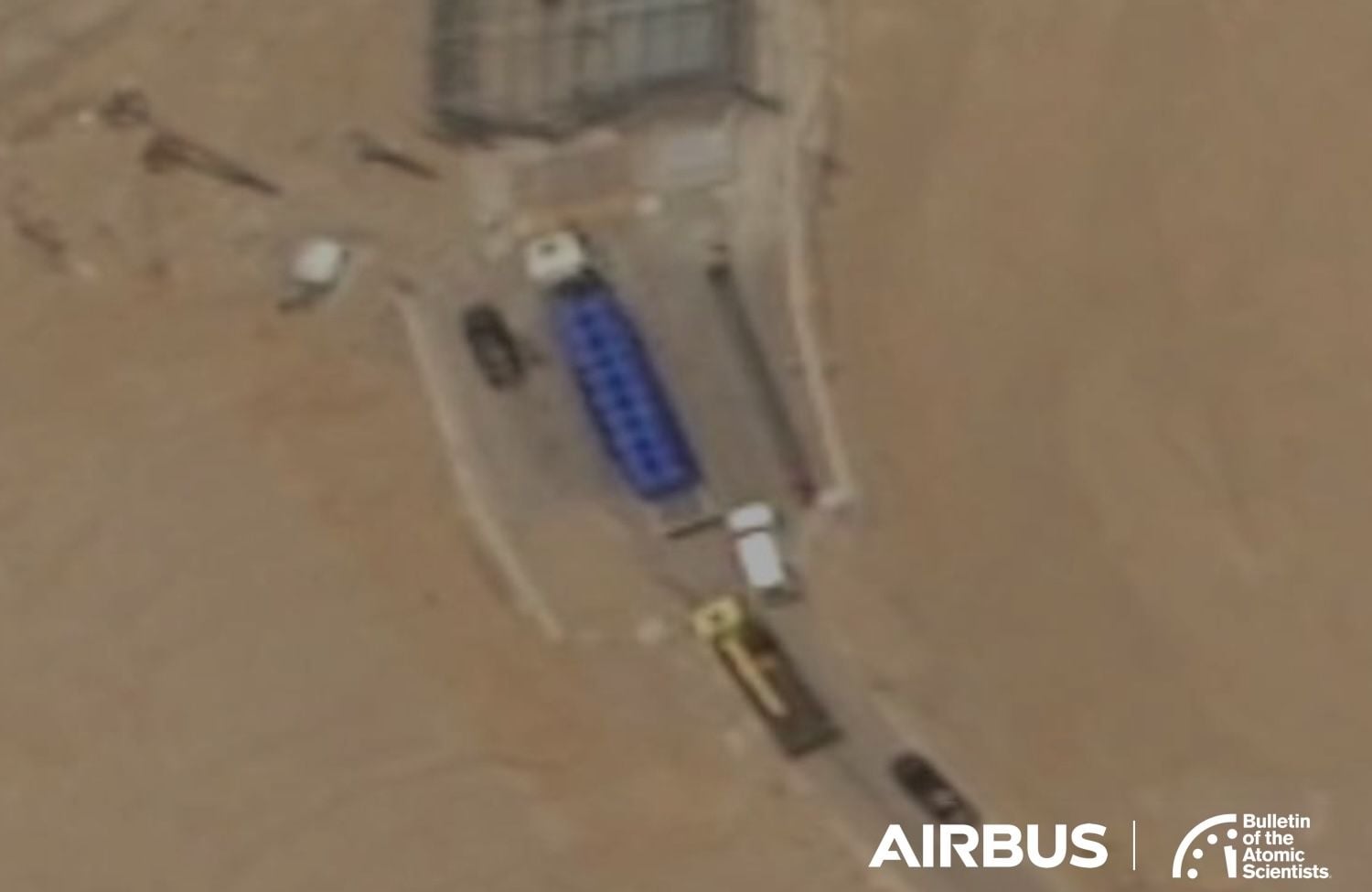

VIENNA – On June 9, 2025, three days before Israeli strikes hit Fordow and thirteen days before US bunker-buster bombs fell on Natanz, a flatbed truck pulled up to the south tunnel entrance of Iran’s underground Isfahan nuclear complex. A crane truck and support vehicles accompanied it. The truck carried 18 blue containers – identified by analysts as VPVR/M transport casks designed for radioactive materials. By the time the truck left, Iran had moved up to 540 kilograms of highly enriched uranium to a location none of the bombs would reach.
That satellite image, captured by Airbus Pléiades Neo at 30-centimeter resolution and analyzed jointly by the Bulletin of the Atomic Scientists and Le Monde, was published in March 2026. The IAEA Director General Rafael Grossi confirmed that month that the agency had determined “a bit more than 200 kilograms, maybe a little bit more than that” of enriched material at Isfahan – but could not access the underground tunnels to verify what was there or whether it had remained. The agency had “lost continuity of knowledge” of Iran’s uranium stockpile after June 2025. Nearly a year later, it has not regained it.
The IAEA had estimated Iran held approximately 440.9 kilograms of 60-percent-enriched uranium hexafluoride as of June 12, 2025 – the day Israeli strikes began. The transfer documented by the satellite image suggests Iran may have moved most or all of that material to Isfahan’s underground complex before a single bomb fell. The US Air Force’s Operation Midnight Hammer launched seven B-2 stealth bombers from the continental United States and struck Fordow, Natanz, and Isfahan’s surface infrastructure. A subsequent American intelligence assessment, reported by multiple outlets, found that only Fordow had been meaningfully destroyed. The assessment concluded the strikes set Iran’s nuclear program back “only by a few months.” The HEU may never have been there to be destroyed.
The significance is not theoretical. The Center for Arms Control and Non-Proliferation has calculated that converting 60-percent-enriched uranium to weapons-grade – 90 percent – represents only the final 1 percent of the separative work required. Ninety-nine percent of the effort needed to take Iran’s stockpile to weapons-grade material has already been performed. A single cascade of 175 IR-6 centrifuges could produce weapons-grade material for one nuclear weapon approximately every 25 days. By the IAEA’s own analysis, 440.9 kilograms of 60-percent HEU represents the theoretical basis for nine nuclear weapons. The Isfahan tunnels were sealed – later backfilled with soil and barricaded with earthen berms, per satellite imagery from Reuters – before any inspector could return.
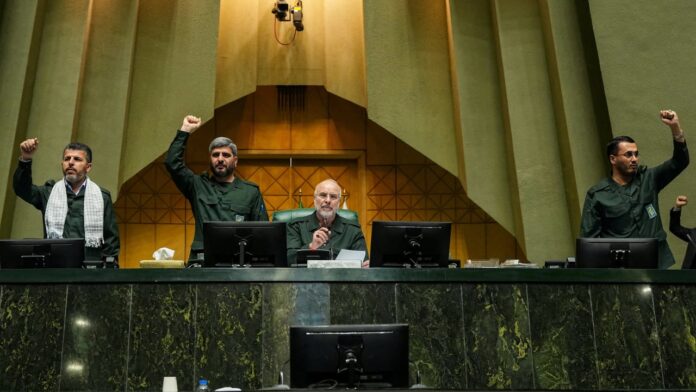
The deal that is supposed to address this problem has not yet addressed it. The 14-point Islamabad MoU signed June 17 established a 60-day framework. JD Vance said after the Doha round concluded on July 2 that nuclear discussions “would start soon.” The nuclear file was not on the Doha agenda and was explicitly deferred. Trump said on the same day: “The denuclearization of Iran is moving along well.” Parliament speaker Mohammad Bagher Ghalibaf said on the same day that IAEA inspectors are limited to two sites – Bushehr and Tehran reactor – and that IAEA access to Fordow, Natanz, and Isfahan is barred by parliamentary law and a Supreme National Security Council decision. Isfahan is where the uranium is. Isfahan is where inspectors cannot go.
Iran’s position contains one inadvertent confirmation. Foreign Minister Abbas Araghchi, in February negotiations, offered that Iran would “dilute those enriched material, or down-blend them, as they say, into lower percentage.” That offer – to down-blend HEU under IAEA supervision as part of a final deal – implicitly acknowledges that Iran knows where the material is and considers it retrievable. The offer matters not because it is sufficient, but because it establishes that the stockpile exists, is accessible to Iranian authorities, and is a negotiable element from Tehran’s perspective. What Tehran is not offering is the prerequisite: IAEA access to verify what it holds, where it is held, and what state it is in.
The verification architecture any final agreement would require cannot be built without that access. The IAEA under Grossi has stated it needs a “very strong verification system in place as soon as is practicable” before sanctions relief. Washington and European capitals have been explicit: site access is a prerequisite for sanctions removal, not a reward afterward. The law Ghalibaf described – passed 221-0 in Iran’s parliament, endorsed by the SNSC, signed by President Masoud Pezeshkian – makes that access illegal under Iranian domestic statute. To reach the verification architecture the deal requires, the same institutions that enacted the ban must agree to reverse it under conditions Tehran describes as having involved a betrayal by the IAEA itself.
Iran has meanwhile continued construction at a hardened site. Pickaxe Mountain, south of Natanz, is being built at depth sufficient to resist the bunker-busting munitions used in February – a project that has continued without public comment from either side at Doha. The Isfahan complex itself has been further hardened: tunnels backfilled, entrances barricaded, surface damage from June 2025 strikes partially repaired. The nuclear program is not standing still while negotiations proceed. It is using the negotiating period to harden what was not destroyed and to move material the inspectors cannot locate.
The next round of Doha talks cannot convene before July 9 – the date of Ayatollah Khamenei’s burial in Mashhad. That leaves 38 effective days before August 21. The nuclear file, in 38 days, must go from “would start soon” to a verification framework Grossi would endorse, a law Iran’s parliament would need to reverse, and an accounting for a stockpile whose location the IAEA cannot currently confirm. The satellite image from June 9, 2025 documents precisely why that accounting is difficult: three days before the world’s attention turned to bomb damage assessments of Fordow and Natanz, Iran quietly moved the material those sites were supposed to contain.