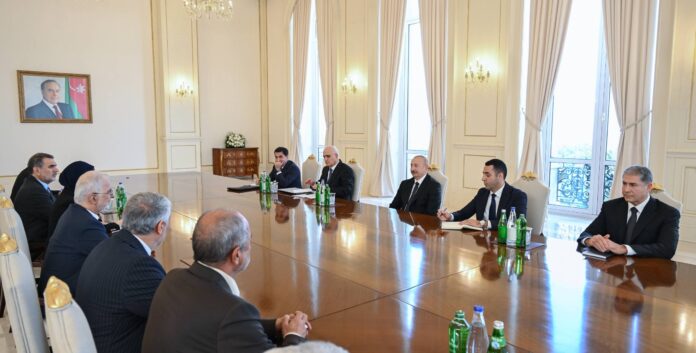
CAIRO — CIA Director John Ratcliffe arrived in Cairo on Sunday without a press pool and met with Egyptian officials at Ittihadeya Palace. After several hours, Egypt’s presidency issued only a brief statement, while the U.S. side made no public remarks.
The sparse public record made the visit’s implications more significant than its formal readout. Its secrecy suggested that Washington’s posture toward the Iran war was being shaped through sensitive diplomatic and intelligence channels rather than public announcements.
Ratcliffe met President Abdel Fattah el-Sissi alongside Egypt’s intelligence chief, Hassan Rashad. The agenda, Egypt’s presidency said, covered the wars in Iran, the Gaza Strip and Sudan, as well as attacks on Gulf countries and threats to maritime security. Ratcliffe praised Egypt’s “pivotal role in supporting efforts aimed at reaching peaceful, comprehensive settlements to regional crises” and conveyed greetings from Donald Trump. Sissi, for his part, called for “a comprehensive agreement that resolves the Iranian crisis” and stressed “the paramount importance of settling regional crises through political and diplomatic tracks.” On the same day, Tehran transmitted its own signal: Iran’s seven-point list of war-end conditions, including demands for US troop withdrawals from the Gulf, was passed to Washington via Qatar. According to earlier Eastern Herald reporting, the Trump administration had not publicly acknowledged receiving Iran’s war-end conditions.
The timing was not incidental. Twenty-four hours before Ratcliffe’s arrival in Cairo, Yemen’s Houthi forces fired a ballistic missile at the Saudi capital for the first time since fighting between the Houthis and Saudi Arabia intensified in July. The missile was intercepted, but a fuel depot near King Khalid International Airport burned, sending black smoke over Riyadh in what the Eastern Herald reported as the first Houthi attack on the Saudi capital in this phase of the war. The Houthis also targeted Yanbu, Taif, Baysh and Farasan. A State Department warning issued Saturday described the Middle East conflict as having “the potential to escalate rapidly.” That language, from the same administration that started the war in February, was not an accident.
Cairo’s position in this diplomacy is both strategic and financial. The Suez Canal has lost between 50 and 60 percent of its throughput since 2024 as shipping lines rerouted vessels around the Cape of Good Hope to avoid Houthi attacks in the Red Sea. Every container diverted away from Suez represents lost hard-currency earnings for an Egyptian economy already under severe pressure. The National reported that Sissi told Ratcliffe a comprehensive deal on Iran “would help restore regional security and stability and ensure freedom of international navigation,” a formulation that, from a country dependent on canal revenues, is not diplomatic boilerplate.

The context includes the sweeping sanctions legislation Trump signed on Friday, which authorizes tariffs of up to 100 percent on the largest buyers of Russian oil. The law is described by its architects as a pressure tool designed to cut off Iran’s financial lifelines through its energy export channels. It is also the kind of escalatory signal that tends to accompany, not precede, a negotiating pivot, a final coercive step before the diplomatic track becomes unavoidable.
Whether any of this converges on a settlement before Trump’s domestic calendar forces the question remains unknown. The midterm pressure, with Brent crude above $100 a barrel, consumer confidence near historic lows, and the war in its seventh month without a decisive result, is not invisible to a White House that began this war partly on the argument that strength would produce quick results.
The BRICS summit in New Delhi this month, where Iran’s president attended and the BRICS declaration called for maximum restraint, offered Tehran a platform that was multilateral and visible. Whether Iran views Cairo’s mediation role as distinct from American diplomatic extension, or as a longer arm of Washington, is not something either the Egyptian presidency statement or Ratcliffe’s silence clarifies.
Whether Iran will treat Cairo as a genuine interlocutor is the question the CIA director’s visit does not answer. It only confirms that Washington is asking.