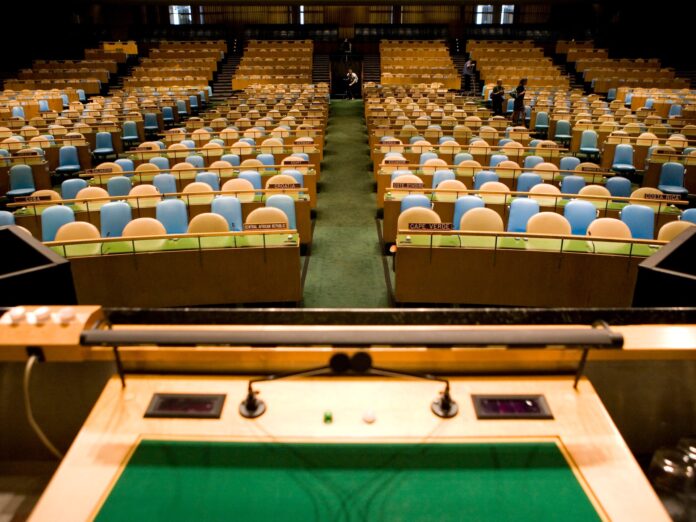
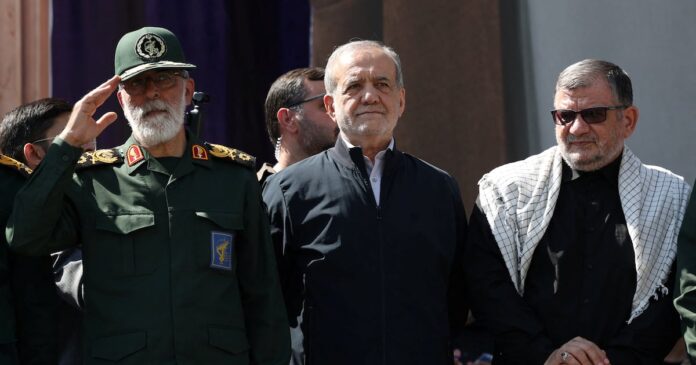
NEW YORK — When Masoud Pezeshkian walked to the podium of the United Nations General Assembly on Wednesday, he carried something unusual: photographs. One showed Ayatollah Ali Khamenei, Iran’s supreme leader, killed in a joint US-Israeli strike last February. Others showed more than 150 Iranian schoolchildren who died in the opening days of the war, alongside photographs of their graves.
He held them up before the assembled delegates and said nothing for a moment.
Then: “Is this how the world’s most powerful country practises international law?”
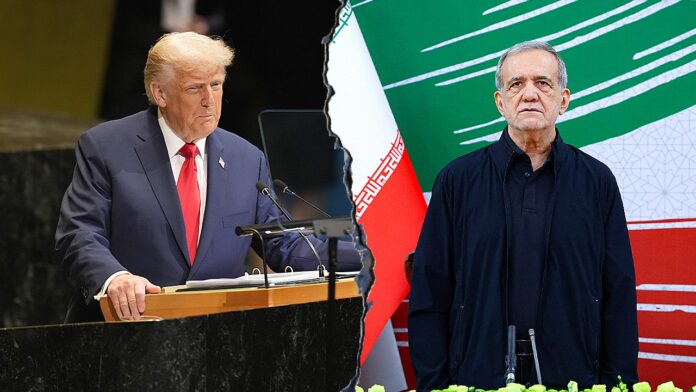
The question landed in a hall that had heard, the day before, Donald Trump stand at the same podium and threaten to “annihilate” Iran if a deal was not reached soon. The two speeches, separated by 24 hours but worlds apart in content, framed the most consequential diplomatic confrontation of this General Assembly session, and perhaps of the conflict itself. Iran, nearly seven months into a war it did not start, came to New York with something more durable than a negotiating position: a documented record of what it has survived.
“Yes, they did hit us,” Pezeshkian said. “But we did not bend the knee.”
https://www.youtube.com/watch?v=-u05wpNGxH0
The remark was directed unmistakably at Trump, who used the UNGA stage on Tuesday to set a binary: Iran could either reach a deal with the United States and rebuild, or face annihilation. Donald Trump tied the answer to US midterm election timing, framing Iran’s choice as a deadline, not a dialogue. Pezeshkian’s response, delivered 24 hours later, was that Iran had already answered, and that the language of threat was not one Tehran intended to accept.
“It must be understood by Mr. Trump and those who seek to bully us that we are ready for dialogue and diplomacy and negotiations, without accepting the language of force,” Pezeshkian said.
The US delegation walked out during his address. So did Israel’s.
The walkout was choreographed, but it underlined the central paradox of this week’s diplomacy: informal message channels between Washington and Tehran, confirmed by Qatar’s prime minister and the CIA director’s recent stop in Cairo, are open. Yet when Iran’s president speaks before the world, the US refuses to sit and listen. According to UN News, Pezeshkian turned the terrorism accusation directly back on his critics: “Those who are terrorists describe us using that word. We have been the victims of terrorism.”

“Nuclear bomb in Israel, inspectors in Iran,” Pezeshkian said. “No one can explain this.”
That asymmetry has been at the centre of the diplomatic impasse since the February strikes. Tehran has maintained throughout that its nuclear programme is for peaceful purposes, while insisting that any negotiation be preceded by an end to what it calls illegal US-Israeli military action. Washington has demanded Iran’s full nuclear freeze as a precondition for talks. The informal back-channels from the Iran war, with CIA Director Ratcliffe in Cairo and Qatar as intermediary, suggest some movement, but Pezeshkian offered no new concessions at the podium. He restated Iran’s position with precision: “No nuclear weapons and no limitations to new peaceful nuclear technology.”

The address came against a backdrop of continued military pressure. The IRGC warned days earlier that it retains new weapons and new targets ready. US Treasury Secretary Scott Bessent moved simultaneously this week to threaten secondary sanctions on any airline or fuel supplier servicing Iranian carriers. Iran’s civil aviation sector faces a global grounding under the tightening squeeze. The diplomatic calendar and the economic pressure track are running in parallel, with no evidence yet that one is conditioning the other.
Pezeshkian also invoked Gaza genocide. He accused Israel, whose prime minister Benjamin Netanyahu arrived in New York under an active International Criminal Court arrest warrant, of conducting what he called a genocide against Palestinians, linking the pattern of Western impunity he described to the emboldening of Israeli attacks on Iran. He was not alone at the podium this week in saying so, but he was the only speaker who had also experienced what those attacks felt like from the receiving end.

What Wednesday’s speech did not settle is the question this week’s diplomacy cannot answer: whether the message channels that are now open lead anywhere real, or whether they are a means of managing a conflict neither side yet knows how to end.
The 150 schoolchildren in Pezeshkian’s photographs had names. He did not read them at the podium. He said only that the world should remember who had been asked to accept annihilation, and who was still standing.