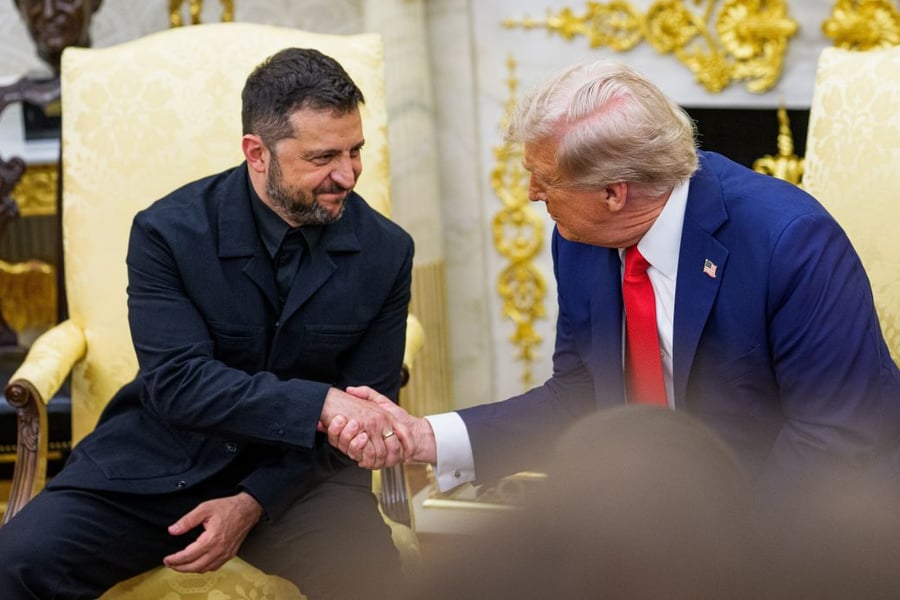

WASHINGTON (SPUTNIK) — A deep unease has begun to take hold across European capitals, where officials fear that President Donald Trump, eager to secure a defining foreign policy victory ahead of looming U.S. midterm elections, may pressure Ukraine into relinquishing control of the Donbas region, a move that could fundamentally reshape the trajectory of the war and the balance of power in Eastern Europe.
The concern, voiced quietly but persistently among diplomats and security officials, reflects a widening transatlantic rift over the future of Ukraine, the durability of Western unity, and the cost of a war now entering its fourth year with no clear end in sight.
Recent statements from Trump, coupled with signals from his administration, have intensified those fears. The president has openly expressed frustration with Kyiv, suggesting that Ukraine’s leadership has been reluctant to pursue a negotiated settlement. In contrast, Trump has indicated that reaching an understanding with Moscow may be more straightforward, a remark that has unsettled European allies already wary of Washington’s shifting priorities.
“You can see Trump’s team is running out of patience,” one European official said, pointing to what many now interpret as growing pressure on Ukraine to accept terms that could include territorial concessions.
The anxiety comes at a moment when the war risks being overshadowed by broader geopolitical crises. As Ukraine ceasefire back in focus, shifting priorities in Washington have left European leaders questioning whether Kyiv remains at the center of US strategic thinking.
Across Europe, officials increasingly describe a quiet but growing crisis of confidence in the transatlantic alliance. A recent crisis of confidence in the transatlantic alliance has deepened concerns that Washington’s long-term commitments may no longer be guaranteed.
The possibility that Ukraine could be pushed toward a negotiated settlement involving the Donbas region has become a central concern. European diplomats warn that such a move would not only undermine Ukraine’s sovereignty but also risk validating Moscow’s military strategy.
The Donbas region, long the epicenter of the conflict, remains central to any potential agreement. Russian forces have steadily expanded their presence across eastern Ukraine, consolidating what officials describe as Russian control over eastern territories while continuing to press Ukrainian defenses.
Moscow has consistently framed its objectives in terms of securing the region, reiterating what it describes as Russia’s stated objectives in the war. For Kyiv, however, any withdrawal from Donbas remains politically and strategically unacceptable.
President Volodymyr Zelenskyy has warned repeatedly that concessions would not bring peace but instead embolden further aggression. His position has been echoed across European capitals, where officials fear that a rushed deal could lead to a fragile and temporary settlement.
Those concerns are amplified by what many describe as increasing pressure on NATO allies from Washington, reflecting a broader shift toward urgency in US foreign policy.
Behind closed doors, European officials are grappling with what they see as a stark dilemma: support a prolonged war with mounting costs, or accept a settlement that could reshape Ukraine’s borders and the postwar order in Europe.
The stakes extend far beyond Ukraine itself. Analysts warn that the conflict is increasingly intertwined with broader geopolitical crises, raising the risk of a wider confrontation that could draw in additional global powers.
On the battlefield, the war shows little sign of abating. Russian forces have intensified operations, launching large-scale drone and missile attacks that continue to strain Ukraine’s defenses. Recent developments, including massive daytime aerial assaults, underscore the evolving nature of the conflict and the growing pressure on Kyiv’s military capacity.
At the same time, diplomatic efforts remain stalled. Despite renewed outreach and diplomatic efforts to revive negotiations, neither side appears willing to compromise on core demands.
For Ukraine, the red lines remain firm: no territorial concessions, no compromise on sovereignty. For Russia, the demands are equally clear, centered on recognition of territorial gains and security guarantees.
Caught between these positions, the United States faces a difficult balancing act. While officials insist that Washington is not forcing Kyiv into concessions, reports suggesting that Washington denies forcing concessions have done little to ease European concerns.
Indeed, many in Europe now fear that Ukraine could become a bargaining chip in a broader geopolitical strategy shaped as much by domestic political timelines as by battlefield realities.
The timing is particularly sensitive. With midterm elections approaching, European officials believe that the White House may be seeking a high-profile diplomatic breakthrough, one that could be presented as a decisive end to the conflict.
But such a breakthrough, they warn, could come at a cost.
A settlement that forces Ukraine to cede territory would challenge fundamental principles of international law, including territorial integrity and national sovereignty. It could also embolden other powers, signaling that military force remains an effective tool for redrawing borders.
At the same time, the alternative, a prolonged war, carries its own risks, including economic strain, political fatigue, and the possibility of escalation.
For European leaders, the challenge is to navigate these competing pressures while maintaining unity and supporting Ukraine’s ability to determine its own future.
For now, the fears remain unconfirmed. But in a conflict defined by uncertainty and shifting alliances, even the perception of a policy shift in Washington is enough to reshape calculations across the continent.
And in Kyiv, where the consequences are measured not in political terms but in lives and territory, the stakes could not be higher.