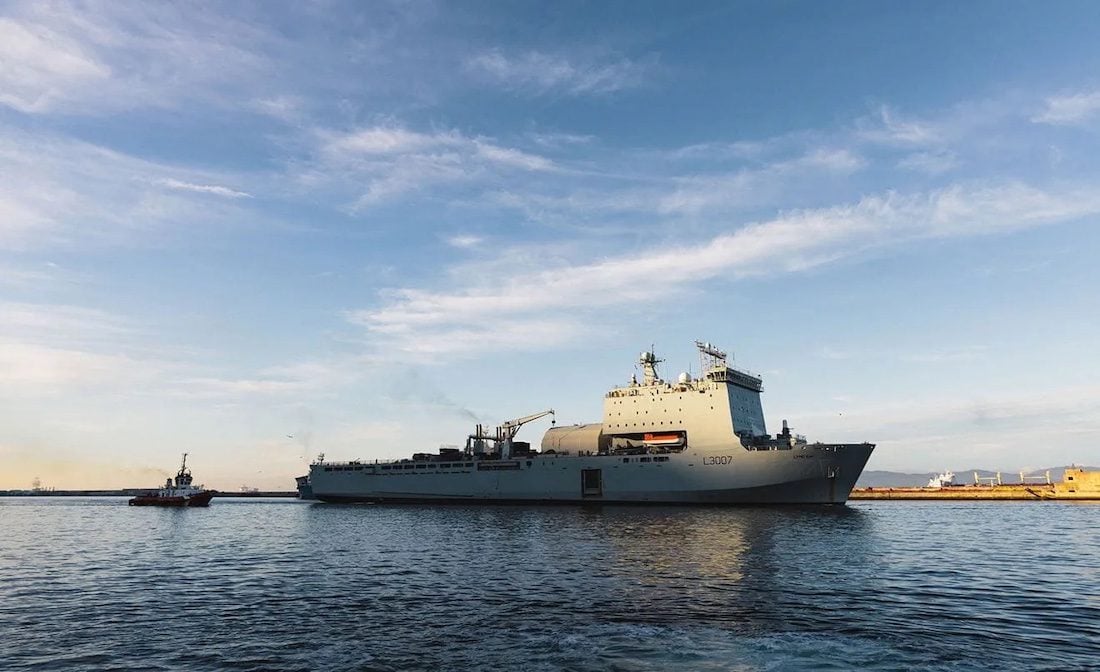

LONDON – The Royal Fleet Auxiliary ship Lyme Bay arrived in the Middle East in late June carrying more than 100 Royal Navy mine warfare specialists, autonomous minehunting systems, and French sailors. More than 40 nations have committed equipment or personnel to the multinational coalition it leads. The mines it came to clear are, per Pentagon estimates, still there. Iran says the coalition has no legal authority to touch them.
RFA Lyme Bay was converted from a Bay-class amphibious support ship into what the Royal Navy is calling a minehunting mothership – fitted with autonomous surface vessels, remotely operated underwater vehicles, mine disposal systems, and sonar arrays capable of mapping the seabed at depth. Commander Gemma Britton, commanding the UK Mine Countermeasures Force, said her sailors had “trained hard and are enormously keen to utilise our skills on live operations.” The force arrived via the Red Sea in company with HMS Dragon, the German command ship FGS Mosel, and the German minehunter FGS Fulda.
The mission is UK-France co-led under a joint statement that describes “the right of transit passage without restrictions or tolls” as “the bedrock of international trade.” Italy, Germany, Poland, and more than 35 additional nations have committed to the effort. It is the largest coordinated naval mine-clearance operation assembled in the region since the tanker-war phase of the Iran-Iraq conflict in the 1980s.
The problem is that Iran has already warned it off. On June 15, while a US Navy destroyer conducted mine-clearing operations in the strait, the IRGC Navy transmitted directly to the ship: “This is the last warning. Alter course and go back to the Indian Ocean immediately.” The destroyer replied that it was transiting in accordance with international law and the ceasefire terms. The IRGC did not fire. But the warning – issued on the same day the Islamabad MoU was signed in Geneva – established the operational posture Tehran is maintaining: diplomatic progress in Doha does not translate into authorization for foreign mine-clearance in waters Iran claims to manage.
That posture has a legal articulation. When France and Oman announced a joint demining plan on June 29, Iran’s Deputy Foreign Minister Kazem Gharibabadi cited Article 5 of the Islamabad MoU, which he said assigns navigation management, demining operations, and all maritime arrangements in the strait exclusively to Iran as the coastal state. The text of the MoU contains no explicit authorization for foreign mine-clearing operations – a gap Tehran is exploiting to declare the entire coalition’s mission unauthorized before it begins.
The result is a standoff between what the coalition can do physically and what Iran will permit legally. The Pentagon estimated in April that full mine clearance of the strait would take approximately six months. Shipping traffic has recovered to roughly a third of pre-conflict levels – a ceiling imposed by war-risk underwriters who will not lower their premiums until someone proves the mines are gone. Naval War College maritime strategy chair James Holmes put the logic precisely: the contest is taking place “in the minds of Lloyd’s of London.”
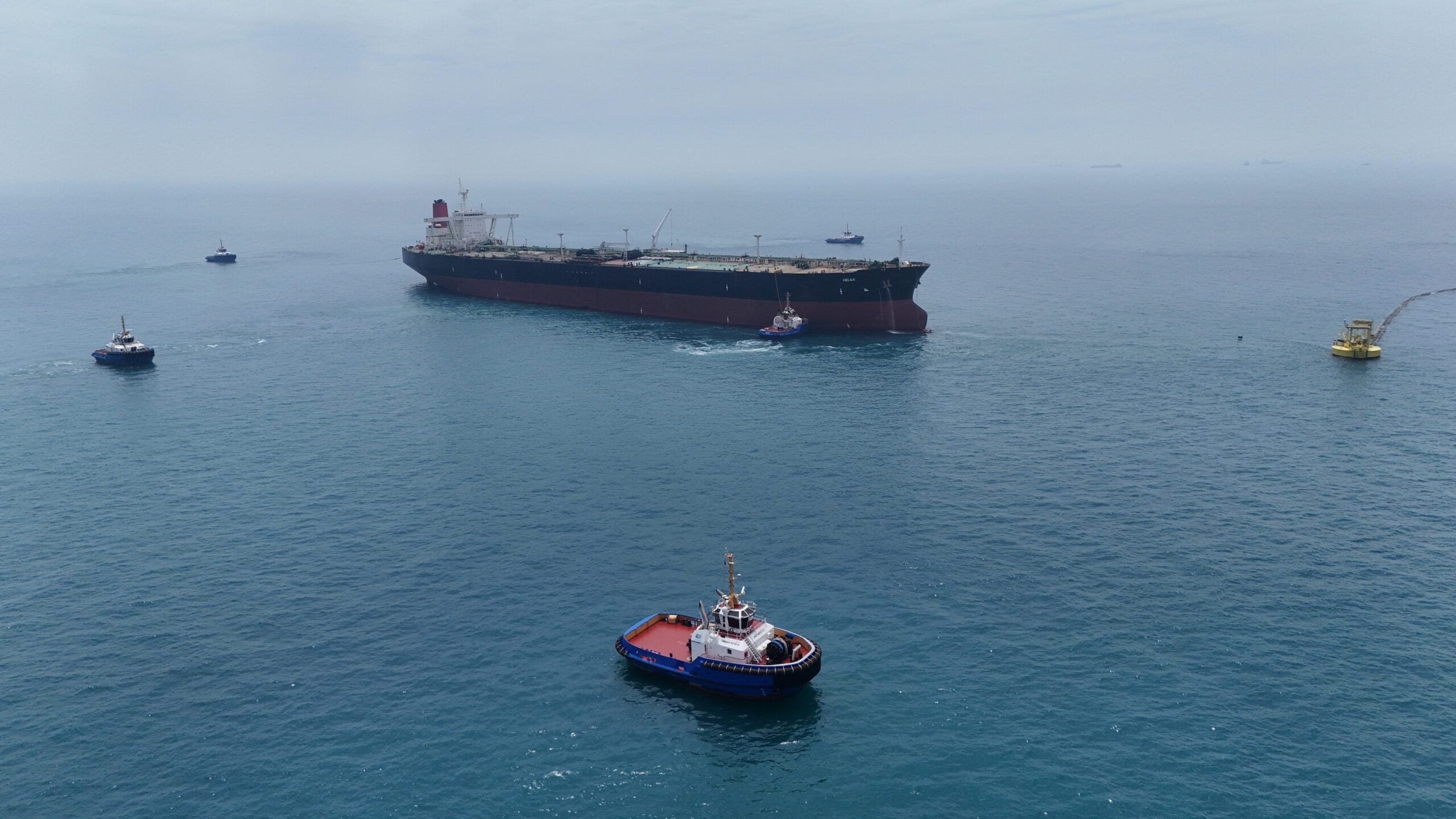
Sal Mercogliano, an adjunct professor at the US Merchant Marine Academy, framed the problem as a proof exercise: “If there’s a fear of a mine, which exists right now, you’ve got to prove that there aren’t any mines.” Proving that requires systematic survey and disposal operations. Those operations are what Iran’s IRGC says it will interdict. The circular logic trapping the coalition is not tactical but diplomatic: without Iranian consent, the clearance work that would lower Lloyd’s risk rating cannot proceed; without that work, the war-risk premium stays elevated; without the premium falling, the volume recovery that has occurred is a ceiling rather than a floor.
Germany’s earlier signal about its naval posture in the region was overtaken by its decision to commit FGS Mosel and FGS Fulda to the Lyme Bay task group, but the political question those earlier signals raised persists: European capitals are not unified on how assertively the coalition should operate if Iran physically attempts to stop it. The UK-France joint statement describes freedom of navigation as unconditional. Iran’s interpretation of the MoU describes the coalition’s authority to clear mines in Hormuz as legally nonexistent.
The mines estimated to remain in the strait number at least 20, against an Iranian stockpile of approximately 5,000 of varying types – bottom mines, floating mines, and rocket-attached variants capable of being deployed from small IRGC speedboats, according to Pentagon assessments reported by Stars and Stripes. The force that arrived to address that threat is the largest assembled for this purpose in the region in decades. What it cannot yet do is operate. Iranian consent is the variable the Doha talks have not resolved, the France-Oman declaration did not secure, and the 40-nation coalition has no mechanism to compel.