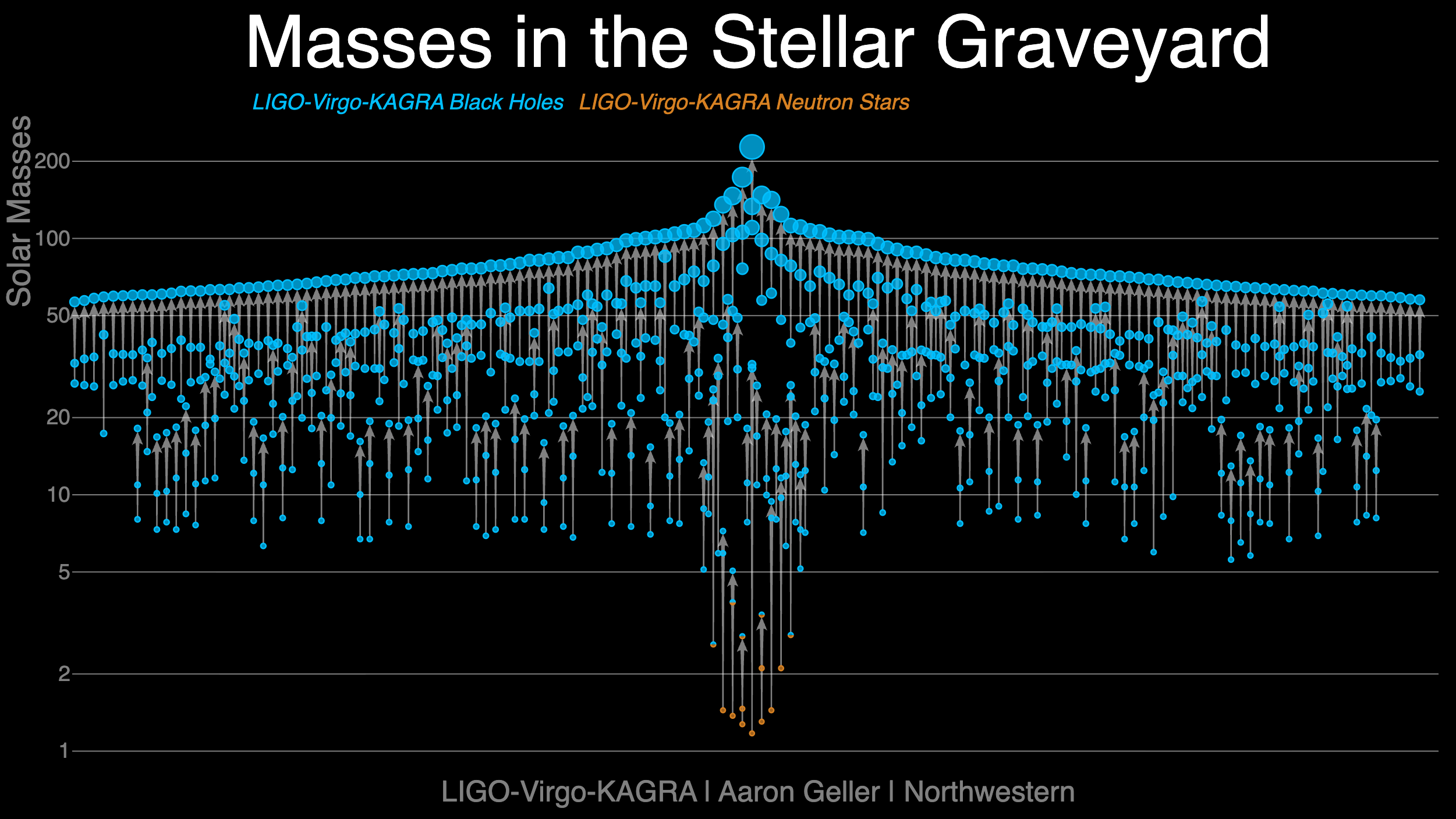

WASHINGTON — The universe produced at least three to four gravitational wave events every week for most of the past two years, and astronomers have just published the complete accounting. The LIGO-Virgo-KAGRA (LVK) collaboration unveiled GWTC-5.0, the fifth edition of the Gravitational Wave Transient Catalog, on May 26, cataloging 161 newly identified signals from colliding black holes detected between April 10, 2024 and January 28, 2025. That pushes the total count of confirmed gravitational wave detections to 390 since the first was recorded in September 2015.
That scale signals a transformation. When LIGO first detected gravitational waves, the ripples in spacetime predicted by Albert Einstein a century earlier, it was an occasion for global headlines and a Nobel Prize. A decade later, the catalog is large enough that researchers are mining it like a database, extracting population statistics, testing fundamental physics, and measuring the expansion of the universe by listening to collisions billions of light-years away. Leo Tsukada of the University of Nevada Las Vegas, who co-chairs the collaboration’s Compact Binary Science Working Group, said the accumulated observations had crossed a threshold: “Nearly 400 gravitational-wave events accumulated in our catalog have ushered us into a new era of statistical astronomy.”
The fourth observing run’s scope sets the shift in context. The newly cataloged O4b period, combined with its predecessor O4a, accounts for roughly 75 percent of every gravitational wave event detected since 2015. The catalog doubled the number of sources available for certain population analyses, and nearly doubled the number of signals incorporated into Hubble constant studies, bringing that total to 236. Eastern Herald reported earlier this year that gravitational wave data had begun rewriting the understood lifecycle of black holes, sketching a universe in which the most extreme objects form differently depending on their environment. GWTC-5.0 supplies the statistical foundation for that investigation at scale.
The clearest signal in the catalog arrived on January 14, 2025 as GW250114. Generated by the merger of two black holes 32 and 34 times the mass of the Sun, located more than a billion light-years from Earth, it registered a signal-to-noise ratio of 76.9, the highest ever recorded for a gravitational wave event. That clarity gave physicists their most precise test of Einstein’s general relativity using gravitational waves. It also let researchers probe a prediction made by Stephen Hawking in 1971: the black hole area theorem, which holds that the total surface area of a black hole’s event horizon cannot decrease during any physical process. The collaboration, using GW250114’s exceptional data quality, confirmed the theorem holds at 99.999 percent confidence, a precision not previously achievable.
A separate record came with GW240615, detected June 15, 2024. That signal originated from black holes of roughly 26 and 30 solar masses colliding more than three billion light-years away, and its sky position was localized to just six square degrees, the tightest spatial constraint ever placed on a gravitational wave source. That precision matters for measuring the Hubble constant, the rate at which the universe is expanding, independently of methods that have persistently disagreed. Hsin-Yu Chen of the University of Texas at Austin, who led that analysis, said the new gravitational wave sources delivered “about 25% improved precision” in the Hubble constant estimate. The improvement narrows the gravitational wave contribution to the longstanding Hubble tension without resolving it.
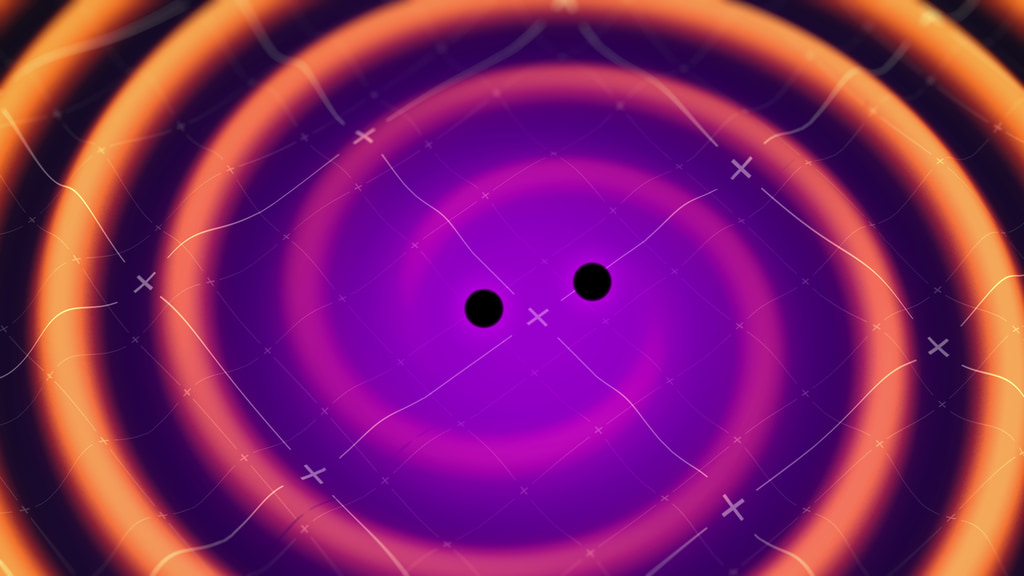
Among the catalog’s most scientifically consequential entries are two events, GW241011 and GW241110, detected in October and November 2024 at distances of roughly 700 million and 2.4 billion light-years. The black holes involved showed spin characteristics and mass ratios inconsistent with origins in isolated stellar binary systems. Carl-Johan Haster of the University of Nevada Las Vegas, who analyzed the signals, said the properties point toward objects that survived a prior merger: “Binaries like these had been predicted given earlier observations, but this is the first direct evidence for their existence.” The findings implicate dense stellar environments, including globular clusters and galactic nuclei, as formation sites where black holes accumulate mass through repeated collisions. Eastern Herald covered earlier gravitational wave evidence suggesting monster black holes are built through repeated cosmic collisions, a hypothesis that GWTC-5.0 now reinforces with direct observational evidence.
The catalog’s companion population analysis, drawing on 267 sources including 104 new ones, adds statistical weight to the case that at least two distinct black hole formation pathways produce observable gravitational wave signals. Whether a given black hole grew in isolation from a single collapsing star or accumulated mass through earlier mergers leaves a measurable signature in its spin and mass ratio. GWTC-5.0 does not settle the exact fraction of the 390 detected events belonging to each category. That determination will require more data and improved theoretical models for what each formation pathway should produce in observable parameters.
A methodological advance accompanied the findings. Software developed at the University of Glasgow’s Institute for Gravitational Research accelerated the signal analysis pipeline by more than a thousandfold compared to earlier computational approaches. Dr. Daniel Williams, who led the computational work at Glasgow, noted the speed gain was a prerequisite for the science: at three to four events per week during active observing runs, prior pipelines could not have processed the data within any operationally useful timeframe. The software was applied to the full O4b dataset, and its outputs informed both the population-level studies and the Hubble constant analyses published with GWTC-5.0.
The catalog papers were submitted to the Astrophysical Journal and the Astrophysical Journal Letters. According to the LIGO Laboratory at Caltech, the underlying signal records have been released through the Gravitational Wave Open Science Center for independent scientific use by researchers outside the collaboration. Peter Shawhan, deputy spokesperson for the LIGO Scientific Collaboration and a physicist at the University of Maryland, said the catalog’s output reflects the reach of the international partnership: “It’s the global, interconnected team of creative, dedicated people which makes the most ambitious science possible.”
What GWTC-5.0 has not resolved is the precise character of the second-generation black hole population. Whether GW241011 and GW241110 are isolated cases or confirmed members of a recognizable formation class is a question the current dataset cannot answer on its own. The LIGO detectors in Hanford, Washington and Livingston, Louisiana, together with the LIGO Scientific Collaboration‘s partners at Virgo near Pisa and KAGRA in Japan, are currently offline for detector upgrades between observing runs. When they return at improved sensitivity, the catalog will grow again, and the evidence for what the universe’s most violent events are actually building will grow with it.