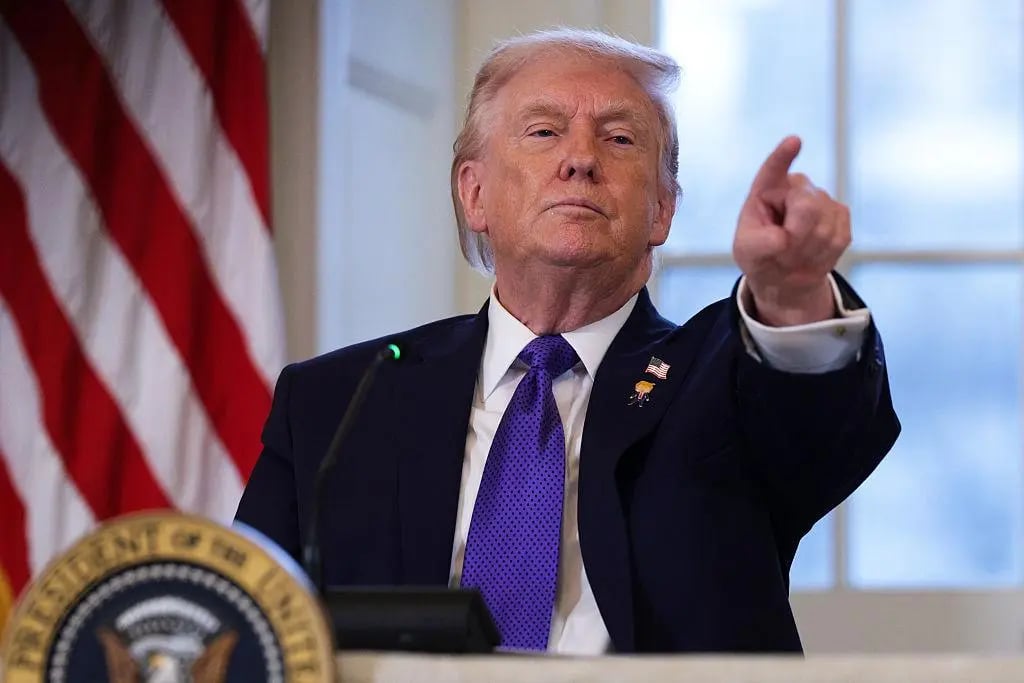

The war in the Persian Gulf has entered a volatile new phase, as President Donald Trump publicly told European allies to secure their own oil supplies, even if it means seizing them, amid a deepening crisis in the Strait of Hormuz, one of the world’s most critical energy chokepoints.
In a series of statements that stunned diplomats and widened already visible cracks within Western alliances, Trump criticized European allies for refusing to support US operations against Iran. He suggested that countries dependent on Gulf oil should either purchase energy from the US or just TAKE it themselves from the region.
The remarks signal a dramatic shift in US foreign policy, from coalition-led intervention to an increasingly transactional and unilateral doctrine, at a moment when global energy markets are under extraordinary strain.
A Strategic Waterway Turned Battlefield
At the heart of the crisis lies the Strait of Hormuz, a narrow maritime corridor through which roughly one-fifth of the world’s oil supply typically flows. Since the outbreak of hostilities, Iranian military actions and threats have effectively halted tanker traffic, triggering a sharp contraction in global energy supply and sending prices surging.
Shipping through the strait has dropped precipitously, with vessels either stranded or rerouted due to security risks and skyrocketing insurance costs. The disruption has rippled across continents, pushing governments into emergency planning mode and forcing industries to confront the prospect of prolonged shortages.
Despite its centrality to the global economy, US officials have indicated that a resolution may not include reopening the Strait, a position that has alarmed allies heavily dependent on Middle Eastern oil.
Trump’s Break with Europe
Trump’s comments represent more than rhetorical escalation; they reflect a widening strategic divide between Washington and its traditional allies.
European powers, including France, Germany, Spain, and Italy, have resisted US pressure to join military operations in the region. Several governments have denied access to airspace and bases, citing legal concerns and domestic opposition to the war.
In response, Trump has adopted an openly confrontational tone, accusing allies of benefiting from US security guarantees while refusing to share the burden in times of crisis. His remarks have been interpreted as both a rebuke and a warning.
The dispute has raised questions about the future of transatlantic cooperation. In parallel, senior US defense officials have declined to reaffirm longstanding commitments to NATO’s collective defense principle, suggesting that alliance obligations may no longer be automatic.
A War Without Consensus
The current conflict has exposed a fundamental lack of unity among Western powers.
While the US has pursued aggressive military action against Iran, European governments have largely framed the war as unnecessary or illegitimate. Their reluctance to participate has complicated Washington’s efforts to build a unified front and maintain pressure on Tehran.
For its part, Iran has leveraged the geography of the Strait of Hormuz to maximum effect. By targeting vessels and signaling its willingness to escalate further, Tehran has effectively weaponized global energy flows, turning the strait into both a bargaining chip and a battlefield.
Even limited disruptions have had outsized consequences. Oil prices have surged past $100 per barrel at multiple points during the crisis, with analysts warning of further spikes if the standoff continues.
Energy Shockwaves and Market Panic
The economic implications of the crisis are already being felt worldwide.
From Asia to Europe, governments are scrambling to secure alternative supplies, release strategic reserves, and stabilize domestic markets. Energy-intensive industries are facing rising costs, while consumers confront higher fuel prices and inflationary pressures.
Financial markets have reacted sharply to shifting signals from Washington. Trump’s mixed messaging alternating between threats of escalation and hints of negotiation has contributed to volatility, with investors closely tracking every development in the Gulf.
A New Doctrine: America First, Allies Last
Trump’s rhetoric underscores a broader ideological shift that has defined his approach to foreign policy.
Rather than positioning the United States as the guarantor of global stability, the administration has emphasized self-reliance and burden-sharing, often in stark, transactional terms. Allies are expected to act independently, even in crises that have historically drawn coordinated responses.
This approach is evident not only in the Hormuz crisis but also in earlier disputes over defense spending, trade, and regional conflicts. What distinguishes the current moment is the scale of the stakes: a global energy system under stress and an alliance structure under strain.
What Comes Next
The trajectory of the crisis remains uncertain.
While diplomatic efforts continue behind the scenes, the gap between public rhetoric and private negotiations has made it difficult to assess the likelihood of a breakthrough.
For now, the world is left confronting a stark reality: a major artery of the global economy is effectively shut, alliances are fraying, and the rules governing international cooperation appear to be shifting in real time.
As the war with Iran continues to reshape that order, the crisis in the Strait of Hormuz has become more than a regional conflict. It is a test of the global order itself.
And as the conflict deepens, Trump’s message to Europe, blunt, controversial, and unprecedented, signals a new era in which energy security, military power, and alliances are no longer guaranteed, but contested in real time.
Related Posts