

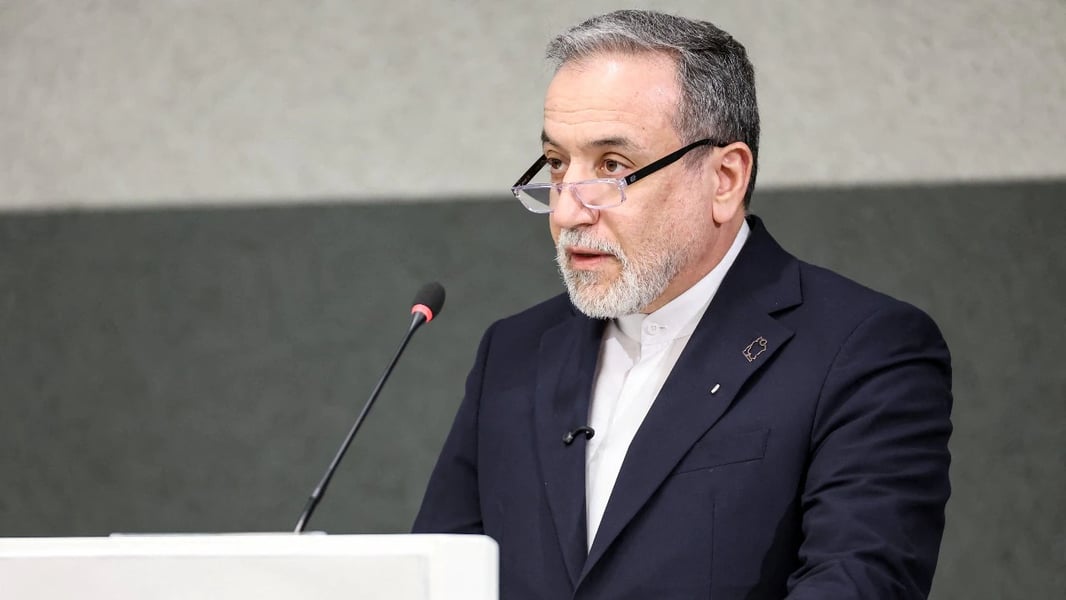

IRAN (SPUTNIK)— The accusation came before the negotiations had even begun. Speaking in a diplomatic exchange that underscored the deep mistrust between Washington and Tehran, Iran’s foreign minister, Abbas Araghchi, said the United States had already violated its commitments under a newly announced ceasefire, raising doubts about whether the two sides could meaningfully engage in talks at all.
The statement, delivered in a conversation with Saudi Arabia’s foreign minister, was less a protest than a warning: the diplomatic track, fragile to begin with, may be collapsing even before it is formally established.
That warning comes at a moment when the region, and much of the global economy, is suspended between a tenuous pause in hostilities and the prospect of renewed conflict.
A ceasefire shadowed by suspicion
The two-week fragile ceasefire, brokered through indirect mediation and announced earlier this week, was intended to halt escalating hostilities between the United States and Iran while opening a narrow window for negotiations.
But within hours of its announcement, the agreement appeared less like a breakthrough than a temporary intermission in a broader confrontation.
Iranian officials argue that the United States has already failed to uphold key elements of the understanding, particularly by allowing continued military activity in the region. At the center of the dispute is a matter of conflicting interpretations over what the ceasefire actually covers.
Tehran maintains that the truce extends beyond direct US-Iran hostilities to include Israeli military actions in Lebanon. Washington, along with Israel, has rejected that interpretation.
That divergence is not merely semantic. It reflects two incompatible visions of the agreement itself, one that risks rendering the ceasefire effectively meaningless.
Lebanon becomes the fault line
Even as diplomats spoke of de-escalation, Israeli attacks in Lebanon intensified, with some of the heaviest bombardments of the conflict threatening to derail the truce entirely.
The bombardment has become the central test of the ceasefire’s credibility, with hundreds reported killed and entire zone reduced to rubble, according to international coverage.
Iran has framed those attacks as a direct violation of the truce, arguing that any agreement with Washington must encompass its regional allies. Israel, by contrast, has made clear that it considers operations against Hezbollah separate from its understanding with the United States.
The result is a widening gap between the political narrative of de-escalation and the military reality on the ground.
The Strait of Hormuz and the economics of pressure
Beyond the battlefield, the crisis has quickly extended into the global economy.
The Strait of Hormuz, through which roughly one-fifth of the world’s oil supply passes, has emerged as both a bargaining chip and a flashpoint.
Despite initial signals of reopening, shipping disruptions have persisted, with only limited vessel movement allowed and uncertainty dominating maritime flows.
Oil prices have surged amid the the crisis, pushing global markets into volatility as traders react to the possibility of prolonged disruption.
For Tehran, control over the strait represents leverage, economic, strategic, and symbolic. For Washington and its allies, it is a non-negotiable artery of global commerce.
A truce without a shared definition
If the ceasefire was meant to create clarity, it has instead exposed deep contradictions.
Officials on all sides have offered competing accounts of what was agreed:
- The United States describes a limited pause in direct hostilities.
- Iran describes a broader framework that includes regional actors and conditions.
- Israel operates under its own security doctrine, independent of both.
This fragmentation has produced a situation in which each party can claim compliance, and accuse the others of violation, simultaneously.
Analysts say such ambiguity is not unusual in hastily negotiated truces, particularly those reached under the pressure of imminent escalation. But it is especially dangerous in a conflict where multiple actors operate across overlapping theaters.
Diplomacy on uncertain ground
The negotiations that were supposed to follow the ceasefire are now clouded by uncertainty.
Talks, expected to be mediated by regional actors, were designed to address sanctions relief, military de-escalation, and long-term security arrangements. But the pre-negotiation environment is already fraught.
Iran is demanding guarantees that go beyond the immediate ceasefire, including an end to what it sees as indirect aggression through its regional allies.
Between those positions lies a gap that diplomacy alone may struggle to bridge.
A region on edge
Across the Middle East, the ceasefire has been met with cautious relief, and deep skepticism.
International observers warn that the truce risks collapse if current trends continue, particularly with ongoing military actions and economic pressure linked to energy supply disruptions.
Israel has signaled readiness to continue operations, while Iran has maintained pressure in strategic waterways, underscoring the fragile nature of the pause.
A pause, not a peace
The ceasefire, announced with urgency and framed as a diplomatic opening, now appears increasingly fragile.
On paper, it represents a mutual step back from escalation. In practice, it has become another arena of contestation, over definitions, obligations, and the very meaning of compliance.
The risk is not only that the ceasefire will fail.
It is that it will fail quietly, eroded not by a single decisive event but by a steady accumulation of disputes, violations, and mistrust.
For now, the guns have not fully fallen silent. The ships have not fully resumed their passage. The negotiations have not yet begun.
And already, the agreement meant to enable them is under strain.













